
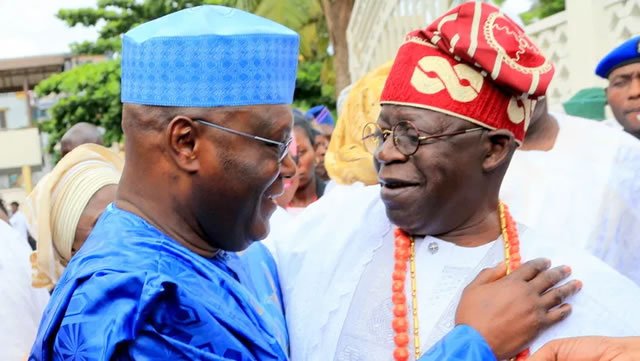
$500,000 Bribery: Atiku Proclaims Innocence, Admits Tinubu’s 1993 Forfeiture not Criminal
Former Vice President and African Democratic Congress (ADC) presidential candidate, Atiku Abubakar, has rejected claims by the All Progressives Congress Presidential Campaign Council (APC PCC) that the Mambilla arbitration established his culpability in the controversial power project.
Atiku, in a statement issued by his Senior Special Assistant on Public Communication, Phrank Shaibu, on Friday, accused the APC PCC of distorting the outcome of the arbitration by presenting allegations considered during the proceedings as though they amounted to a finding of corruption against him.
He said the ruling party had taken portions of the tribunal’s award, stripped them of their legal context and used them to construct what he described as a political narrative against him.
According to him, the APC’s argument was based on the assumption that because he served as Vice President during the administration of former President Olusegun Obasanjo, he should automatically be held responsible for every decision taken by the government.
Atiku said such reasoning was contradicted by his documented disagreements with the administration, citing his opposition to Obasanjo’s controversial third-term bid as an example.
He maintained that he had no role in the technical evaluation and procurement processes that resulted in the selection of Sunrise Power for the Mambilla project.
“The same principle applies to Mambilla. I was not a member of the technical process that evaluated the competing proposals and recommended Sunrise. I did not sit on the procurement panel. I did not award the contract,” he said.
He challenged the APC to produce the specific portion of the tribunal’s award where it allegedly found that he received a $500,000 bribe, directed former Power Minister Olu Agunloye to award the contract to Sunrise, abused his office or participated in a corrupt conspiracy.
“There is no such finding,” Atiku declared.
He also disputed the APC’s interpretation of a $500,000 transaction involving businessman Leno Adesanya, China Castle Investments and Jennifer Douglas.
According to Atiku, the tribunal rejected Adesanya’s explanation that the transaction arose from a foreign-exchange deal because of insufficient documentary evidence supporting the explanation.
He, however, argued that the rejection of Adesanya’s explanation did not amount to a finding that the money was a bribe paid to him or that he corruptly used his office to influence the award of the Mambilla contract.
“The APC cannot manufacture the missing finding simply because the actual award does not provide the political conclusion it desperately wants,” he said.
Read Also:


Atiku also denied the claim that he deliberately refused to appear before the tribunal after being summoned.
He explained that he was not a party to the arbitration and did not testify before the tribunal, adding that the reported contents of the award did not establish that he had been summoned, ordered to testify or found to have disobeyed any directive to appear.
He noted that although former Presidents Olusegun Obasanjo and Muhammadu Buhari, as well as former ministers Babatunde Fashola and Suleiman Adamu, participated in Nigeria’s defence, their appearance could not be construed as evidence that he had been summoned and refused to appear.
Atiku further pointed out that the arbitration proceedings were between Sunrise Power, the Transmission Company of Nigeria, Leno Adesanya and the Federal Republic of Nigeria.
He said the tribunal dismissed Sunrise’s claims and ordered Sunrise and Adesanya to reimburse Nigeria for 75 per cent of its legal fees and expenses, adding that no damages, costs or other personal liability were imposed on him.
The former Vice President also drew a comparison between the Mambilla controversy and a 1993 United States court proceeding involving President Bola Tinubu.
Atiku cited an October 4, 1993 ruling by Judge John A. Nordberg of the United States District Court for the Northern District of Illinois, which ordered the forfeiture of $460,000 held in an account in Tinubu’s name.
He acknowledged, however, that the proceeding was a civil forfeiture case involving property and not a criminal conviction of Tinubu personally for drug trafficking.
Atiku argued that the same evidentiary standard should apply to all political actors, insisting that allegations should not be presented as established facts without corresponding findings in judicial or arbitral records.
He challenged the APC to publish the specific paragraphs of the Mambilla award which, it claimed, established that he solicited or received a bribe, instructed Agunloye to award the contract to Sunrise or was otherwise culpable of corruption in connection with the project.
“These are not questions of political opinion. They are questions of record. They have factual answers,” he said.
Atiku urged Nigerians to focus ahead of the 2027 elections on issues including the cost of living, employment, insecurity and the effects of the Tinubu administration’s economic policies.
He maintained that Nigerians should distinguish between allegations and formal adjudications, accusing the APC of attempting to give campaign claims the appearance of an international tribunal’s findings.
“An allegation is not a finding. Suspicion is not proof. The rejection of one man’s explanation is not the conviction of another man,” Atiku said.
“Until the APC produces the portions of the award it claims support its accusation, it should stop dressing campaign allegations in the robes of an international tribunal.”





 presidential candidate, Atiku Abubakar, has rejected claims by the All)