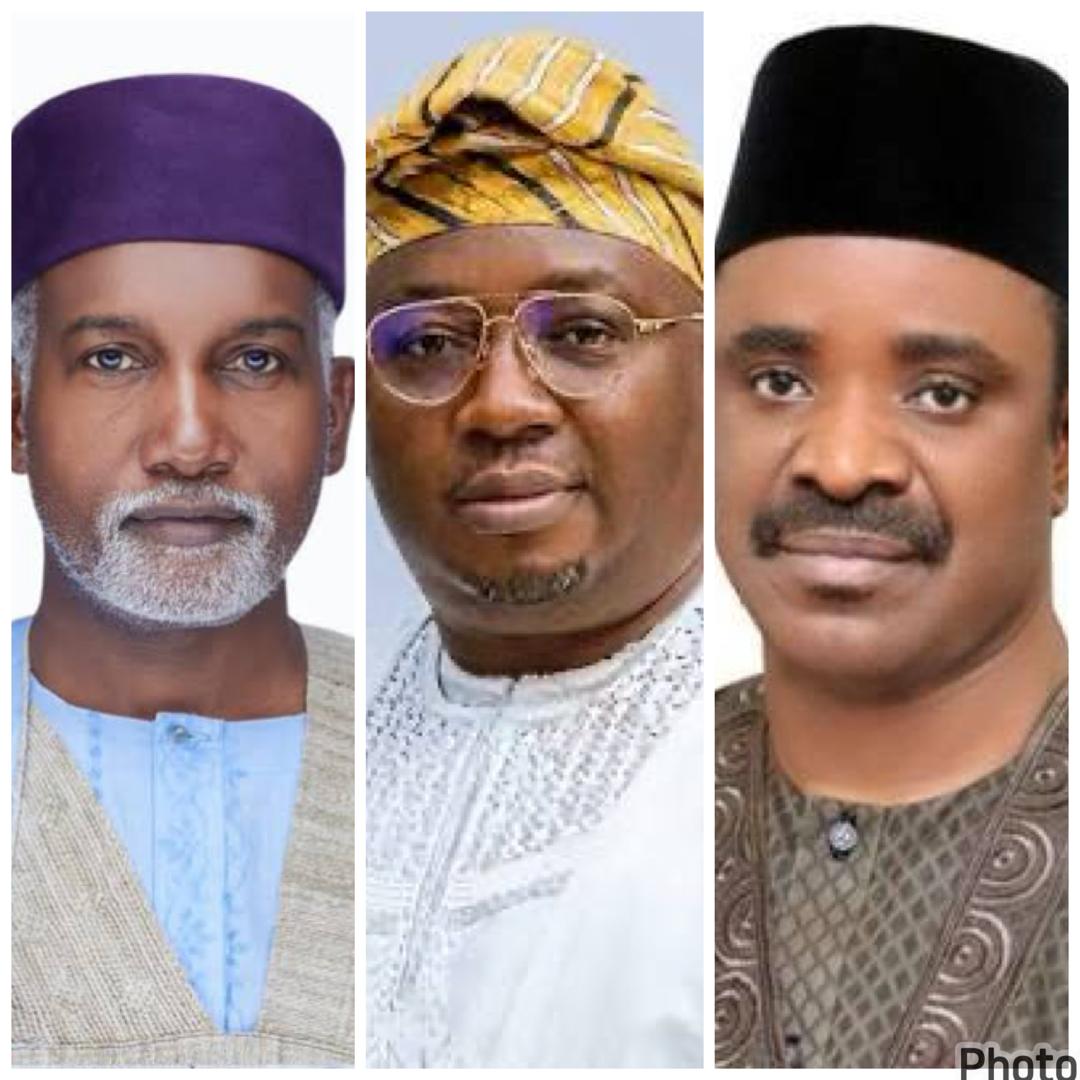
EXCLUSIVE: How 3 Powerful Tinubu Ministers Lost APC Guber Tickets
By Ozumi Abdul
“O ti lo” — a Yoruba phrase now popularised in Nigerian social circles as a humorous but firm way of saying something has been lost, slipped away, or is no longer within reach.
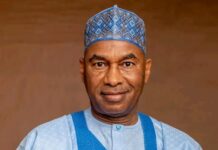
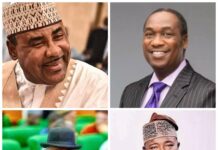
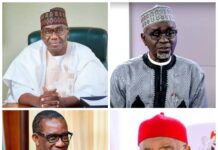
It sounds light when spoken, almost casual, but it often carries the weight of finality that needs no further explanation. This phrase is the current metaphor of Adebayo Adelabu, Yusuf Tuggar and Sa’idu Alkali, and their political reality with uncomfortable precision.
They left powerful ministerial positions in Abuja, betting that governorship tickets back home would naturally follow. Instead, they discovered that political ambition can evaporate just as quickly as it is declared.
In politics, one day, they say can mean a year, but paradoxically for the trio, their “one day” came thick and fast. O ti lo, it’s indeed gone. Maybe their ambitions were taller than them, just as the former governor of Kogi State, Yahaya Bello hilariously taunted his former political adversary and SDP candidate during the 2023 governorship election, Yakubu Murtala Ajaka, when the latter paid him a reconciliatory visit few weeks ago .
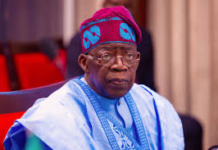
There is always this kind of silence that follows political defeat in Nigeria’s power circles, not the loud kind that comes with public drama, but the quieter one that settles in after the phone stops ringing and the promises start thinning out. Just weeks earlier, they were sitting at the Federal Executive Council table as influential ministers under President Bola Tinubu. Today, they are back to the uncertainty of internal party politics, having traded some of the most powerful offices in the country for governorship tickets that never came.
All three stepped down from their ministerial roles with confidence, backed by the belief that proximity to the Presidency and federal authority would translate into dominance at home. But the APC primaries told a different story, a different political ball game all together, one shaped less by Abuja influence and more by local loyalties, old rivalries, and deeply rooted state political structures.
*Adelabu’s High-Stakes Gamble in Oyo*
Former Minister of Power, Adebayo Adelabu, carried into Oyo politics the weight of both ambition and expectation. His resignation from the cabinet was not just a procedural step; it was a declaration that he was ready to bet his national influence on a return to state-level leadership.
Officially, he said he left to comply with electoral rules and focus on his governorship ambition.
Read Also:
But within APC circles, there was unease. Some insiders at the time said he was reluctant to leave a ministry still central to Tinubu’s reform agenda, while others insisted he had the President’s approval before stepping aside. Adelabu himself maintained he resigned with full clearance from the Presidency.
Still, politics in Oyo proved far less predictable than Abuja consultations.
By the time delegates converged, the contest had already hardened into a struggle over influence, loyalty networks, and long-standing grievances within the state APC. Despite his national profile, Adelabu struggled to fully consolidate the grassroots structures needed to secure victory.


Party elders had reportedly advised caution, warning that the race was already too fragmented for any easy win.
When the votes were eventually counted, his ambition collided with political reality, and Oyo quietly summed it up in the phrase: “o ti lo.”
*Tuggar’s Bauchi Dream Crashes*
Yusuf Tuggar entered the Bauchi governorship race with the confidence of a man who had represented Nigeria on the global stage and sat at the centre of diplomatic power. As Foreign Affairs Minister, he was one of the most visible faces of the Tinubu administration abroad.
That visibility, however, did not translate into political dominance at home.
He resigned in line with the Presidency’s directive and quickly positioned himself as the APC’s reform-minded alternative in Bauchi.
But inside the party structure, another force was already at work, the deep-rooted machinery of former governor Mohammed Abubakar, who retained strong influence over delegates and local party blocs.
The outcome was decisive. Abubakar secured a commanding victory over Tuggar in the primary, leaving the former minister far behind in delegate support.
Party insiders later described Tuggar’s challenge as a familiar one in Nigerian politics: strong national profile, weak local anchoring.
*Alkali’s Troubled Gombe Bid*
Sa’idu Alkali’s journey in Gombe carried a different kind of tension, less about numbers and more about internal fractures.
As Minister of Transportation, he had been part of a powerful federal team, but his return home exposed unresolved divisions within the state APC. His ambition for governorship triggered competing interests that quickly turned the primaries into a contested and unsettled exercise.
Reports pointed to disagreements, factional suspicion and allegations of irregularities that weakened cohesion within his camp.
In the end, Alkali could not pull together enough support to secure the ticket, despite stepping down from his ministerial role to focus fully on the race.
In Oyo, Bauchi and Gombe, the verdict was the same, ambition met resistance, and resistance won. And in the language now common in Nigerian social circles, it all ended simply: “o ti lo.”