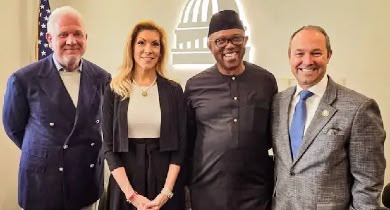
EXPLAINER: Why Peter Obi Says His Washington Meetings Were Not About 2027 Endorsement
By Abbas Badmus,
As political activities gather momentum ahead of Nigeria’s 2027 general elections, the recent visit of the presidential candidate of the Nigeria Democratic Congress (NDC), Peter Obi, to Washington, DC, has generated debate over the purpose and significance of his engagements with American political figures.
While reports surrounding the visit suggested that Obi might have been seeking international endorsement for his presidential ambition, the former Anambra State governor has rejected the interpretation, insisting that his discussions centred on Nigeria’s democratic future, governance and citizens’ welfare.
In a clarification issued on Wednesday, November 18, 2026, Obi said his engagements with US congressional leaders were not an endorsement-seeking mission but an opportunity to discuss issues affecting Nigeria.
Here are the key issues surrounding the visit and the controversy it generated.
What Was the Purpose of Obi’s Washington Visit?
Obi said his visit was aimed at engaging American political leaders and other influential stakeholders on Nigeria’s development challenges and democratic future.
According to him, the discussions covered democratic governance, institutional accountability, citizens’ welfare and the need for free, fair, transparent and credible elections.
He maintained that the engagements were not designed to advance his personal political ambition or secure foreign support for his 2027 presidential campaign.
In his words, the mission was about Nigeria, its people and the future of its democracy, rather than the endorsement of any individual political aspirant.
Who Were the American Figures He Met?
In an earlier statement on Tuesday, Obi disclosed that he arrived in Washington on Monday, November 16, for a series of engagements with American political figures.
Among those he identified were members of the US House of Representatives, including Congressman Marlin Stutzman and Congresswoman Beth Van Duyne.
Others were former Congressman Todd Tiahrt, Suzanne Bock Grisham and retired US Army Colonel Albert V. Short.
Obi also disclosed that he granted an interview to American television commentator Glenn Beck, during which they discussed Nigeria’s development challenges, accountable leadership and resource management.
Additionally, he addressed a gathering on Capitol Hill, where he highlighted the importance of international cooperation in tackling Nigeria’s security challenges, strengthening national unity, promoting economic prosperity and advancing democratic development.
Why Did Obi Issue a Clarification?
The NDC presidential candidate said some media reports had misrepresented the nature of his Washington engagements, portraying them as an attempt to secure foreign endorsement ahead of the 2027 elections.
Rejecting the narrative, Obi said he neither sought endorsements nor presented his meetings in those terms.
He described such interpretations as sensational and misleading, warning journalists and commentators against reducing important diplomatic and political conversations to headlines that distort their actual purpose.


Obi also encouraged other Nigerian political leaders, particularly those seeking elective offices, to engage international stakeholders on issues affecting the country.
Read Also:
He argued that constructive dialogue and the exchange of experiences with international partners could contribute to strengthening Nigeria’s democratic institutions.
What Is the Controversy Over the US Congressional Meeting?
The clarification came amid questions about the nature and official status of the event Obi attended in Washington.
Karl Von Batten, a representative of Washington-based lobbying firm Von Batten-Montague-York, challenged suggestions that the US Congress had officially met with or endorsed the former Anambra governor.
The firm, which was hired by former Vice-President Atiku Abubakar, described the gathering as a private engagement rather than an official congressional meeting.
Von Batten acknowledged that Congressman Marlin Stutzman and Congresswoman Beth Van Duyne were present but stressed that neither served on the House Foreign Affairs Committee or its Subcommittee on Africa.
He further stated that no official of the US State Department’s Bureau of African Affairs attended the event.
“Congress did not meet with or endorse Mr Obi. The event he attended was private, and no one in the video is a member of the House Foreign Affairs Committee or its Subcommittee on Africa,” Von Batten said.
The distinction is important because the presence of individual American lawmakers at a private gathering does not automatically amount to an official endorsement by the US Congress or the American government.
Does Meeting US Lawmakers Amount to Foreign Endorsement?
Not necessarily. There is a distinction between meeting individual American politicians, engaging international stakeholders and receiving an official institutional endorsement.
A meeting with members of the US Congress provides an opportunity for political engagement and discussions on issues of mutual interest. However, such an encounter does not, by itself, establish that the US Congress, its committees or the American government supports a particular Nigerian politician or presidential candidate.
This distinction lies at the centre of the disagreement surrounding Obi’s Washington visit.
While Obi has defended the engagements as discussions about Nigeria’s national interests, Von Batten has cautioned against presenting the private gathering as an official congressional engagement or endorsement.
What Does the Visit Mean for Nigeria’s 2027 Elections?
Obi’s Washington engagements come at a time when political parties and presidential aspirants are intensifying activities ahead of the 2027 general elections.
For opposition politicians, international engagements can provide opportunities to communicate their perspectives on governance, democracy, economic development and security to influential global stakeholders.
However, the controversy also highlights the importance of accurately distinguishing between diplomatic engagement, private political meetings and formal institutional endorsements.
Obi’s position is that Nigerian political leaders should not avoid international conversations about the country’s challenges simply because elections are approaching.
Ultimately, the significance of the Washington visit may lie less in questions of political endorsement and more in the issues raised about Nigeria’s democratic institutions, accountability, security and development.
As the 2027 political contest approaches, the debate underscores the need for credible elections and responsible political communication, both at home and in Nigeria’s engagements with the international community.