NIPSS Memoir: When a Title Becomes a Battleground
By Fashola Abayomi Olawalarami
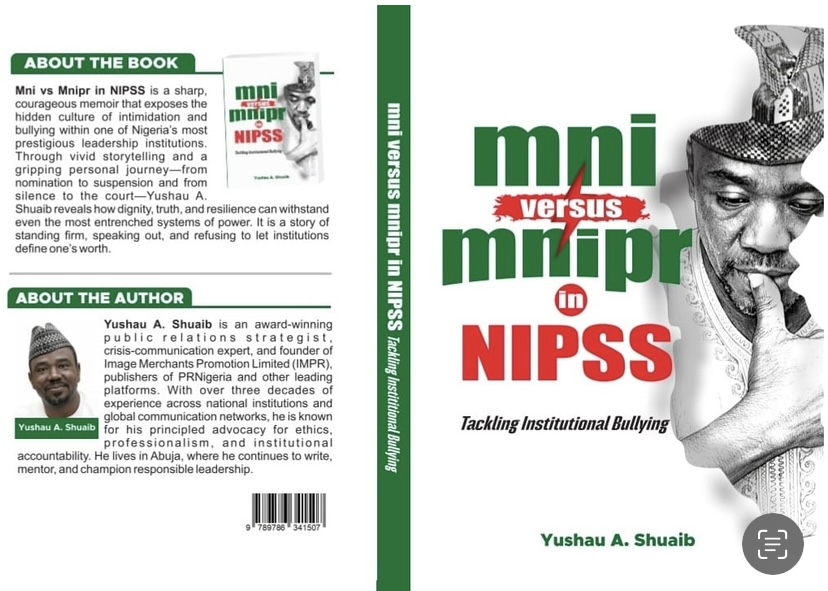
The question that stayed with me throughout my reading of Yushau A. Shuaib’s memoir, MNI Versus MNIPR in NIPSS: Tackling Institutional Bullying, was simple but unsettling: what exactly should a professional be willing to sacrifice in order to earn a title?
By the time I closed the final page, only one word echoed in my mind — wow. I searched for an answer to that question, but none came. Perhaps that is precisely the point of the book.
For context, Yushau Shuaib is the CEO of Image Merchants Promotion Limited (IMPR), the organisation behind PRNigeria, and the convener of the fellowship I am currently part of.
Reading this memoir was not just an academic exercise; it felt personal. It offered a deeper look into the mind of someone whose institution is shaping my own journey as a young communicator. Still, I have tried to maintain an objective stance in this review.
The 205‑page memoir recounts his experience during the Senior Executive Course (SEC 47) at the National Institute for Policy and Strategic Studies (NIPSS), Kuru — one of Nigeria’s most prestigious leadership institutions.
The membership title mni is widely regarded as one of the highest honours a professional can attain. On paper, it sounds like an opportunity many would do anything to secure.
Unfortunately, Shuaib’s account reveals a far more complicated reality, one where discipline sometimes crosses into outright humiliation.
The memoir begins with a call from the President of the Nigerian Institute of Public Relations (NIPR), Dr. Ike Neliaku, informing Shuaib of his nomination for SEC 47. Despite initial reluctance, he accepted. But the institute could not pay the ₦18.2 million training fee, forcing him to seek external support.
He received assistance from the Vice President, Senator Kashim Shettima; the National Security Adviser, Malam Nuhu Ribadu; the former Chief of Defence Staff, General C.G. Musa; and logistical support from the Comptroller‑General of Customs, Bashir Adewale Adeniyi.
One thing I deeply admire is Shuaib’s ability to recount months of emotional and physical ordeal with clarity and precision. Not everyone can do that.
One moment that struck me was how a simple introduction using his professional title “mnipr” escalated into an institutional crisis. That single incident led to a blanket ban on all participants using their hard‑earned professional titles — titles many had spent decades building. Imagine being told, in a room full of your peers, that the letters behind your name suddenly mean nothing.
It didn’t stop there. Shuaib describes being ordered to stand throughout a session despite available seats — an act he interpreted as deliberate humiliation.
He recounts accomplished professionals being forced to write apology letters “like school children begging for forgiveness.” He narrates how a directing staff barked “pocketing!” at an internationally celebrated academic who casually rested a hand in his pocket.


A respected female advocate was sharply reprimanded for deviating from the “approved NIPSS style of presentation.” These incidents paint a picture of grown adults — directors, senior officers, grandparents — reduced to silence and stripped of basic dignity.
Read Also:
What troubled me most was the sacrifice these participants made. These are not idle people. They left families, businesses and responsibilities to spend ten months in Kuru. For military participants, the minimum rank is Colonel; for civilians, Directors of MDAs.
These are senior citizens at the peak of their careers. Shuaib himself began the course during Ramadan, a period of spiritual and physical strain, and had to bring his son along for support. When you weigh that sacrifice against the treatment described, the emotional weight becomes clearer.
The memoir goes beyond NIPSS. Chapter Eight, “The NIPR Betrayal,” is one of the most emotionally charged sections. After more than three decades of loyalty to NIPR — dating back to 1992 when he won the President’s Prize at Bayero University — Shuaib found himself abandoned by the same institution that nominated him.
The shift was painful to read: addressing him as “anipr” instead of “mnipr,” removing his title from official correspondence, and conferring the prestigious FNIPR title on the NIPSS Director‑General, Professor Ayo Omotayo, in the middle of the crisis. It felt like politics, power and institutional self‑interest overshadowing loyalty.
Chapter Nine, “A Blessed Disappointment,” is the emotional turning point. Despite developing hypertension for the first time in his life due to the ordeal, Shuaib found unexpected blessings. His disrupted research project became another book: AI in Crisis Communication in Nigeria.
And during a visit to PRNigeria’s Kano centre, Professor Adamu Abubakar Gwarzo donated a massive building in Abuja for accommodation and training. In a strange way, the setback became a setup for something bigger.
By Chapter Eleven, “The Judgement Day,” the memoir becomes reflective. What began as a harmless report in a seminar room had grown into a full legal battle. Yet the message is clear: institutions can challenge a person, but they cannot erase what that person has built within themselves.
To be fair, this memoir is Shuaib’s perspective. NIPSS has publicly defended its disciplinary process as lawful and standard. A balanced picture would require internal records and accounts from other participants. Still, the memoir’s emotional truth remains powerful.
Personally, I believe the NIPSS Code of Conduct — especially the apology‑letter requirement — functions as a tool of control. When an institution demands remorse even when a participant disagrees with the accusation, it becomes a mechanism for silencing dissent. If NIPSS can suspend participants, withdraw them, or strip titles, then it risks producing not leaders, but puppets.
What I appreciate most is that Shuaib did not write this book quietly. He put his name on it, fully and publicly. That is courage.
In the end, MNI Versus MNIPR in NIPSS is not just about one man’s clash with an institution. It is a broader conversation about how power operates in Nigerian institutions, how hierarchy can forget humanity, and how even accomplished professionals can be stripped of dignity in spaces meant to elevate them.
If I could make one recommendation, it would be this: the Federal Government should include compulsory mental‑health evaluation and therapy at the end of NIPSS’s ten‑month programme. It is necessary.
If there is one lesson I am taking away, it is that titles may come with a name, but integrity must come with the person. Institutions can grant recognition, but they cannot manufacture character. That is something you build long before any course — and long after it ends.
Fashola Abayomi Olawalarami
Email: [email protected]