NIPSS Memoir: The Political Cost of Institutional Authority
By Mukhtar Bio Jibril
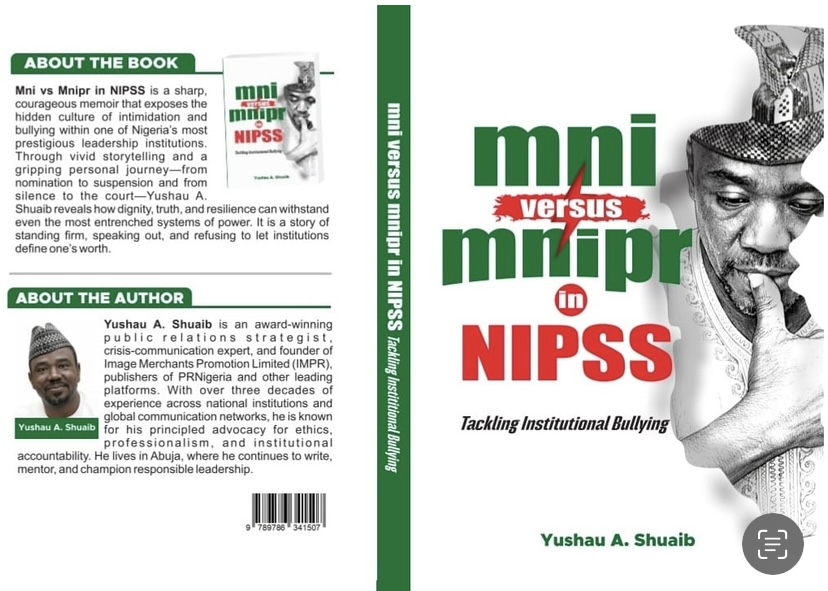
The Political Emotions is the chapter of “MNI Versus MNIPR in NIPSS: Tackling Institutional Bullying” authored by Yushau Shuaib, which offers one of the memoir’s most revealing insights into how ambition, competition and human emotions shape experiences within institutions.
It shows that leadership does not begin with winning an election or holding a title; it begins with how power is exercised in everyday interactions, especially when interests differ.
The election of leadership for the participants at the National Institute for Policy and Strategic Studies (NIPSS), captured between pages 60 and 64, is a striking example.
Participants of Senior Executive Course 47 (SEC 47) competed for various positions, yet the electoral committee, chaired by Professor Paschal, emphasised unity over rivalry. The eventual winner, Colonel Mukhtar Sani Daroda, reinforced this spirit by thanking his opponents for their support after the election.
For me, this moment shows that competition need not destroy relationships. People can pursue leadership positions while still respecting one another, and institutions thrive when ambition does not overshadow humanity.
Another compelling section of the chapter appears under the subheading When Order Overrides Dialogue. Here, Shuaib draws a clear contrast between the civilian and military directing staff.
Some of the security sector directing staff relied heavily on their post nominal “mni” and often interpreted disagreement as a challenge to authority.
Their approach was harsh, confrontational and rooted in command culture. In contrast, the civilian directing staff—except for the “Iron Lady”—were approachable, humble and willing to engage in intellectual debate. Participants could disagree with them without fear of being belittled.
This contrast reveals an important lesson about leadership: authority without approachability creates silence, not progress.
When leaders focus too much on control, people become afraid to express their views. But when leaders are open to dialogue, they gain insight into the people they lead and create an environment where everyone can contribute meaningfully.
Ultimately, Chapter Five shows that leadership is not merely about holding power; it is about how that power is used to build trust, encourage participation and strengthen relationships.
Beyond Chapter Five, the memoir itself is a courageous account of the author’s experience during Senior Executive Course 47 at NIPSS.
It goes beyond personal narrative to raise broader questions about discipline, professional identity, institutional authority and the relationship between individuals and the institutions they serve.
The story begins with Shuaib being nominated by the Nigerian Institute of Public Relations (NIPR) to represent the body at SEC 47. The ten month programme is designed to expose professionals from diverse fields to strategic thinking and national leadership.
His early experience at Kuru was impressive, filled with anticipation and a sense of purpose. But the narrative soon shifts as the excessive use of authority by some directing staff begins to overshadow the academic environment.
The first query came when a PRNigeria report about NIPSS was flagged. Shuaib explained that he had relinquished editorial responsibilities to senior editors upon resumption at NIPSS, as required by the programme.
Read Also:


He neither authored nor published the article. Yet he was issued a query and instructed to rewrite his response in the “NIPSS style.”
A second query followed over an article on the Blue Economy—an article that did not mention NIPSS. This time, the disciplinary action escalated from a query to suspension and eventually withdrawal from the course.
His relationship with NIPR—his professional family—also became strained. The memoir recounts how the institution he had served for decades failed to provide the support he expected.
This disappointment led him to seek redress in court, transforming what began as an academic disagreement into a legal battle.
One of the strongest themes in the book is institutional power. Shuaib does not deny the importance of rules; rather, he questions how those rules are applied. He recounts how an accomplished man was publicly rebuked simply for receiving a call with his hand in his pocket.
He also describes how his use of the “mnipr” title became an issue, despite being a professionally earned designation. These incidents highlight how institutional authority, when applied without emotional intelligence, can undermine dignity.
Another important theme is discipline and dignity. Shuaib does not reject discipline; he insists that discipline must be administered with fairness and respect. Institutional conflicts are not always about rules—they are also about perception, identity and the emotional impact of how those rules are enforced.
As a reader, I found myself disturbed by the emotional and health consequences the author endured. His son’s words—“Your health matters more”—capture the human cost of institutional conflict.
The memoir also teaches courage. Shuaib’s refusal to conform to any style that weakened his stance demonstrates the importance of speaking up in the face of intimidation. His resilience is evident in how he transformed his setback into intellectual growth.
The research topic he initially proposed at NIPSS later became the foundation for his book AI in Crisis Communication in Nigeria. This shows that professional setbacks can become launching pads for new opportunities.
Stylistically, the memoir is written in simple, accessible language. It combines personal storytelling with reflections on leadership and ethics.
The chronological arrangement makes the narrative easy to follow, and the chapter titles—Arrival into Discipline, Queries and Breaking Point, Suspension and the Fight for Voice, The NIPR Betrayal, A Blessed Disappointment—create a sense of movement from opportunity to conflict, disappointment and resilience.
One of the book’s greatest strengths is the author’s courage. Writing publicly about conflict involving respected institutions and senior individuals requires confidence and conviction.
This memoir opens the eyes of readers to the excessive use of institutional authority and may encourage institutions to review their leadership styles.
In conclusion, MNI Versus MNIPR in NIPSS: Tackling Institutional Bullying is more than a memoir. It is a reflection on power, leadership and the individual. It reminds us that institutions must not become so powerful that their rules are applied without fairness or dignity.
The book invites readers to think critically about how institutions exercise authority and how individuals can respond when their professional independence is threatened.
It is a recommended read for professionals, public servants, students of public relations, organisational leaders and anyone interested in institutional power.
Mukhtar Bio Jibril [email protected]