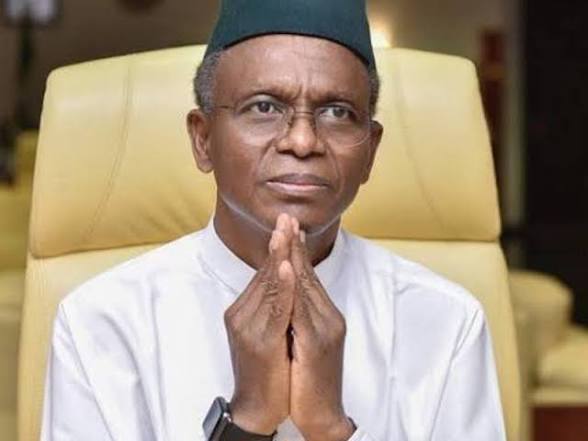
El-Rufai, Informal Authority and the Transience of Power
By Ozumi Abdul
In every setting, there is always an informal authority.
In the office, it may be the secretary who knows when the boss is available and who gets to see him. In a religious institution, it may be the imam’s trusted aide, the church administrator or the person who has served the pastor for years.
In a school, it may be the clerk who knows the principal’s routine. In politics, government, business, the military, traditional institutions and even the home, there are people whose names may never appear on the organisational chart but whose influence is difficult to ignore.
They are security guards, drivers, maids, messengers, personal assistants, receptionists, clerks and aides.
Formally, many of them sit near the bottom of the hierarchy. They are not members of the board. They do not sign government policies. They do not sit in cabinet meetings. They do not make laws. They may not even be consulted when major decisions are being taken.
Yet, they can wield enormous power. Their power comes from access.
The driver knows where his principal goes after official engagements. The security man knows who enters and who waits outside.
The domestic aide knows the moods, routines and preferences of the person he serves. The secretary knows which files reach the desk first. The personal assistant knows which telephone calls are returned and which messages are ignored.
In other words, the formal organisational chart may tell us who has authority, but it does not always tell us where influence actually resides.
Research and organisational studies have long recognised that informal networks and gatekeepers can determine who gains access to decision-makers, whose voices are heard and which proposals receive attention.
That is why it is dangerous to mistake rank for influence. A messenger may not approve an appointment, but he may know the person who does.
A driver may not award a contract, but he may be able to whisper into the ear of the person who awards it.
A security guard may not determine who gets an audience with a minister, governor or business executive, but he can determine whether the visitor gets through the gate.
The same principle operates at the highest levels of politics.
And perhaps nowhere is the lesson more compelling today than in the political drama surrounding former Kaduna State Governor, Nasir El-Rufai.
Nigeria has always understood this phenomenon, even if we have not always given it an academic name.
There was a time when gaining admission into some of Nigeria’s prestigious universities could be almost as politically valuable as securing a coveted job in the Nigerian National Petroleum Corporation, now NNPC Limited.
Admission was scarce. Places were limited. Parents were desperate. Connections mattered.
And in those days, stories abounded of ordinary university employees, messengers, clerks, security men and other low-ranking workers who knew precisely which door to knock on, which official to approach and whose name to mention.
The point is not to romanticise or legitimise admission racketeering. It was, and remains, a damaging distortion of merit.
But the older stories reveal something deeper about Nigerian society: proximity to power can sometimes matter more than position in the hierarchy.
The messenger therefore became more than a messenger. The security man became more than a security man. The secretary became more than a secretary.
They became bridges, and sometimes, bridges determine who crosses the river.
The same thing happens in politics
Politics merely magnifies this phenomenon.
There are elected authorities and there are informal authorities. There are governors, senators, ministers, presidents and party chairmen. But surrounding them are traditional rulers, retired politicians, businessmen, religious leaders, elders, former office holders, political financiers, community leaders, aides and trusted intermediaries.
Some hold no current elected office.
Some have no constitutional authority. Yet, one telephone call from them can secure a meeting with a president that another person may spend months trying to obtain.
One conversation can calm a political crisis. One intervention can stop an appointment from being cancelled. One word can persuade a party to reconsider its position.
One visit can turn a confrontation into reconciliation.
This is why political power should never be measured only by the office someone occupies.
There is formal power, which comes from an office. There is institutional power, which comes from controlling an organisation. And there is relational power, which comes from knowing the people who control institutions.
The third can become particularly important when the first disappears.
That is where the El-Rufai story becomes instructive.
Kaduna-based public commentator Mahdi Shehu has offered a provocative explanation for why, in his view, some influential Northern elders have remained distant from El-Rufai during his current legal troubles.
Shehu argues that El-Rufai’s present isolation is partly connected to the relationships he built, and sometimes destroyed, while he occupied enormous political power.
According to Shehu, during the 2023 presidential campaign, El-Rufai dismissed the relevance of Northern elders, arguing that those claiming elder status should first submit themselves to the people through elections.
Contemporary reporting confirms that El-Rufai said he had become an elder at 63 and that there were no elders with dignity in the North, remarks that drew criticism from former governor Attahiru Bafarawa.
Shehu’s argument is simple but powerful: some of the people El-Rufai allegedly dismissed when he was powerful may be among those capable of helping him now that his political power has diminished.
He says one influential Northern elder, who he believes has direct access to President Bola Tinubu, could potentially intervene on El-Rufai’s behalf but has chosen not to.
Shehu also recounted the alleged experience of an elderly Kaduna landowner who, according to him, had held a plot for decades before its revocation under El-Rufai’s administration.
These claims cannot be readily ascertained, but the larger question they raise is too important to ignore.
What happens to a powerful politician when the informal network around him disappears?
Read Also:
This is the part of power that many politicians fail to understand.
When you are governor, people wait outside your office.
When you leave the office, you wait outside someone else’s. When you are a minister, telephone calls are returned immediately.
When you are no longer a minister, your calls may suddenly become “missed calls”. When you control appointments, people remember your birthday.


When you no longer control appointments, some people may forget your name.
When you have the power to revoke a man’s land, stop his appointment, influence his business or determine whether his proposal gets attention, it is easy to believe that your authority is permanent.
It is not.
The greatest mistake a person in power can make is to confuse temporary authority with permanent influence.
El-Rufai himself once understood this principle.
In July 2025, he warned politicians still in power that their time would end and that others would eventually take their place, saying plainly that “power is transient.”
The irony is striking.
The man who once wielded enormous authority is now experiencing precisely the kind of political vulnerability that comes when formal power disappears.
This is not to suggest that El-Rufai’s political career was built entirely on arrogance or confrontation.
Far from it.
One of the defining features of his political personality has been his willingness to challenge powerful interests.
In 2019, while serving as Kaduna governor, he said he had helped “retire” political godfathers in Kaduna and argued that the same could be done elsewhere. When his comments generated controversy, he refused to apologise, insisting that democracy required room for people to express their views.
That was El-Rufai at his most recognisable: direct, confident, combative and unwilling to retreat simply because powerful people were offended.
There is something admirable about political courage. Democracy needs people who can challenge godfatherism. It needs people who can tell powerful interests that their time is over. It needs public officials who are prepared to make difficult decisions.
But courage has a shadow. When courage loses humility, it can become arrogance. When decisiveness loses empathy, it can become insensitivity.
And when a leader begins to believe that everyone below him is expendable, he may discover after leaving office that many of those people were actually part of the bridge that connected him to society.
That is perhaps the most important lesson from El-Rufai’s current predicament. Power does not merely disappear when an office ends.Sometimes, it reverses direction.
The person who once needed no introduction suddenly needs someone to introduce him. The man who once had hundreds of people seeking his attention suddenly needs people to answer his calls.
The official who once controlled the machinery of government becomes dependent on the same institutions he once commanded to respect his rights.
That is not unique to El-Rufai. It is the cycle of political life.
Nigeria has seen governors, ministers, military rulers, party leaders and political kingmakers rise to extraordinary heights only to discover that influence is rarely inherited by the person who occupies the office after them.
Even people appointed by a powerful leader may eventually distance themselves from him.
Former Kaduna senator Shehu Sani made a similar observation about El-Rufai’s political isolation, arguing that many people who served in his administration had not publicly defended him and describing the situation as a lesson in the transient nature of power.
This is not necessarily betrayal.
Sometimes it is survival. Political followers understand that the man who appointed them yesterday may no longer be able to protect them tomorrow.
That is why politicians should build something stronger than loyalty purchased through appointments, they should endeavour to build goodwill.
But elders must also rise above personal grievances, which brings about another side to the argument.
If Mahdi Shehu’s account is correct that some elders who could intervene have chosen not to because of their grievances against El-Rufai, that raises questions not only about El-Rufai but about the meaning of eldership itself.
An elder is not merely an old person. An elder particularly within traditional African social structures, is expected to mediate, reconcile, counsel and restrain.
If an elder responds to the arrogance of a younger man with greater arrogance, then both have surrendered to the same weakness.
That does not mean elders should shield El-Rufai from accountability, no, they should not.
Neither traditional status nor political connections should place anyone above the law.
If the allegations against El-Rufai are proven, he should face the consequences. If they are not proven, the law should say so.
The ICPC says El-Rufai was remanded pursuant to court orders while it investigated allegations including money laundering and abuse of office. It has also said the courts declined successive bail applications, including a medical-ground application in June 2026.
Separately, the DSS filed a three-count charge alleging unlawful interception of the communications of National Security Adviser Nuhu Ribadu. Those are allegations before the courts, not convictions.
El-Rufai has become one of the sharpest critics of the Tinubu administration. In April 2025, he described the Federal Government as the “worst” in Nigeria’s history and accused it of corruption, dishonesty and intolerance.
Whether one agrees with that assessment is another matter.
But it demonstrates how quickly political alliances can change.
The former APC governor eventually left the party and joined the opposition political space.
Today, he is facing legal battles while the political system he once helped operate remains in the hands of others.
That is precisely why the case deserves to be examined beyond the personality of El-Rufai.
The question is not simply whether El-Rufai deserves sympathy.
The question is whether Nigeria is building a political culture in which institutions, rather than relationships, determine justice.
If he has a case to answer, let the prosecution prove it. If the evidence is weak, let the courts decide.
If he qualifies for bail under the law, let the law determine it. And if he is guilty, let the conviction come through due process.
That is the only sustainable standard.
The same standard must apply to everyone, whether friend or enemy, governor or messenger, elder or youth, member of the ruling party or opposition.