Nigeria @66: What Have We Done With Our Freedom?
By Nafisat Bello
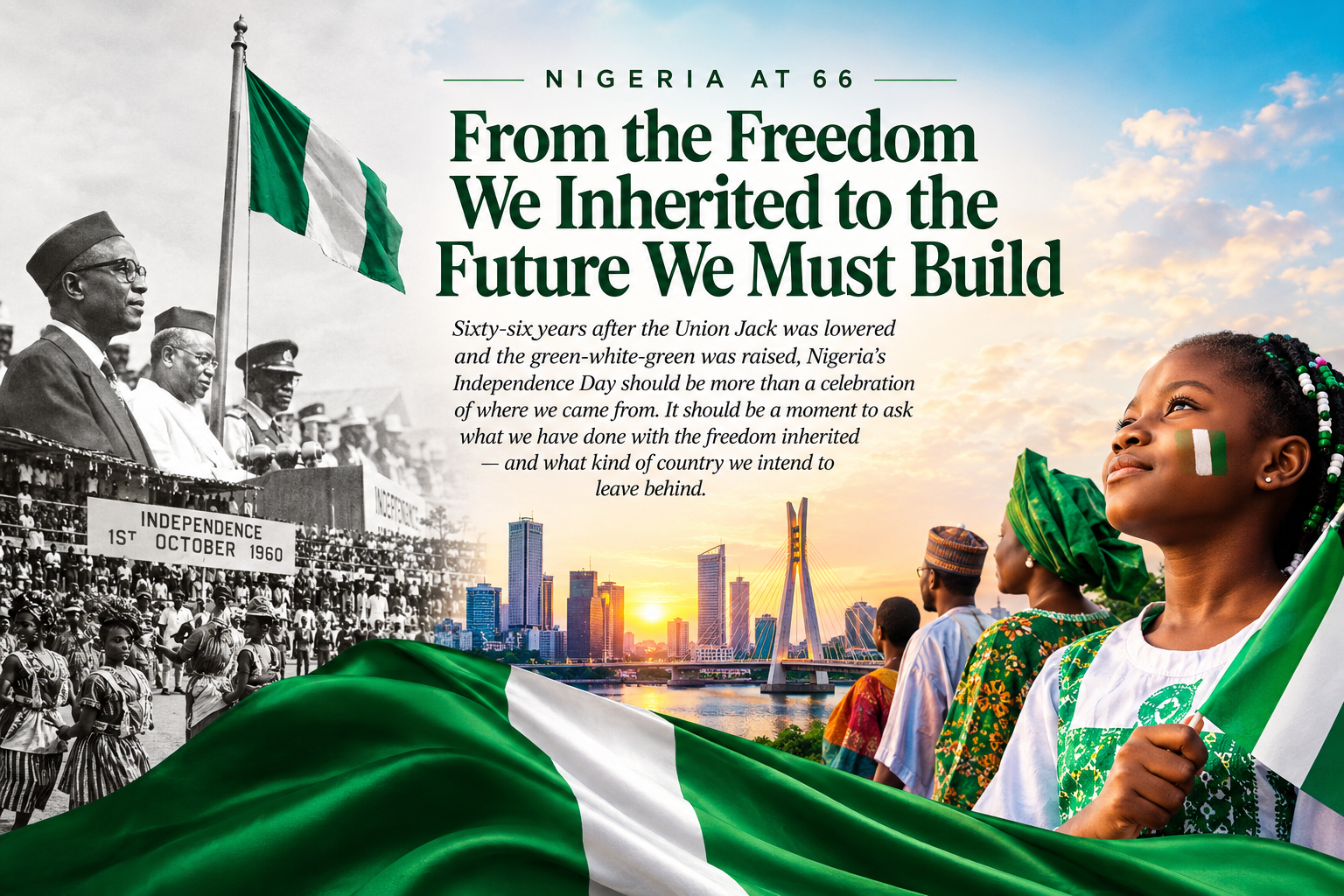
Sixty-six years after the Union Jack was lowered and the green-white-green flag was raised, Nigeria’s Independence Day should be more than a celebration of where we came from.
It should also be a moment to ask a more uncomfortable question: what have we done with the freedom we inherited, and what kind of country are we building for those coming after us?
On October 1, 1960, Nigeria became independent from British colonial rule. The occasion marked the culmination of years of political agitation, constitutional negotiations and nationalist struggles.
It was not the achievement of one man or one political party, but the product of the efforts of many Nigerians who, despite differences in region, ideology and political ambition, contributed to the demand for self-government.
Among the prominent figures of that era were Herbert Macaulay, Nnamdi Azikiwe, Obafemi Awolowo, Ahmadu Bello, Abubakar Tafawa Balewa and Anthony Enahoro. Their approaches differed, sometimes sharply, but their political activities helped shape the journey towards independence.
Nigeria’s road to freedom was also a constitutional one. The Richards Constitution of 1946, the Macpherson Constitution of 1951 and the Lyttleton Constitution of 1954 progressively expanded Nigerian participation in governance. Constitutional conferences in London and Lagos in the late 1950s eventually paved the way for independence.
And so, on October 1, 1960, Nigeria took its place among the independent nations of the world.
Abubakar Tafawa Balewa became the country’s first Prime Minister, while Nnamdi Azikiwe later became Nigeria’s first indigenous Governor-General. The ceremony was filled with symbolism: the British flag came down, the Nigerian flag went up, speeches were delivered, music played and celebrations spread across the country.
For Nigerians at the time, independence represented possibility. It was the promise that Nigerians would determine their own political destiny and shape the direction of their country.
But independence was never supposed to be the end of the journey, It was the beginning.
From celebration to responsibility
Every October 1, Nigerians revive the colours, music and memories of independence. Green and white dominate public spaces. Schools organise cultural displays. Families gather. Traditional dances, songs and food remind us of the extraordinary diversity that makes Nigeria unique. Public holidays declared.
From Hausa traditions in the North to Yoruba heritage in the Southwest, Igbo traditions in the Southeast, the rich cultures of the Niger Delta and the hundreds of other ethnic communities across the country, Nigeria’s identity has always been larger than any single group.
That diversity was part of what made independence significant. Nigeria was not born as a culturally uniform nation. It was born as a country of different peoples who had to find a way to live, govern and prosper together.
That task remains unfinished.
The decades after independence have been marked by enormous achievements, but also by political instability, military rule, civil war, economic difficulties, corruption, insecurity, unemployment, infrastructure deficits and deep social inequalities.
Successive governments have attempted, in different ways and under different circumstances, to address these challenges.
From the First Republic to the military era, from the return to democratic rule in 1999 to the administrations of Olusegun Obasanjo, Umaru Musa Yar’Adua, Goodluck Jonathan, Muhammadu Buhari and now Bola Ahmed Tinubu, each administration has inherited a different Nigeria and left behind its own record of policies, achievements, controversies and unfinished business.
Obasanjo’s years were associated with institutional and economic reforms, debt relief and efforts to reposition the Nigerian economy.
Yar’Adua’s administration was marked by the Niger Delta amnesty programme, electoral and constitutional debates, and the challenges created by his prolonged illness and eventual death in office.
Jonathan’s administration faced the Boko Haram insurgency, corruption allegations and economic pressures, but it also oversaw the 2015 election that produced Nigeria’s first transfer of federal power from an incumbent party to an opposition party through the ballot box.
Read Also:


Buhari’s administration placed heavy emphasis on security, anti-corruption, infrastructure, agriculture and economic diversification, while Nigerians also experienced recession, inflation, unemployment and intense debate over the government’s handling of insecurity and economic management.
Then, came Tinubu.
The Tinubu administration inherited an economy already facing serious fiscal and structural pressures and introduced major reforms almost immediately, most notably the removal of the petrol subsidy and changes to the foreign-exchange regime.
But these reforms have consequences, and Nigerians have felt many of them directly through increased living costs and pressure on household incomes. The debate over the administration, therefore, cannot be reduced simply to political slogans.
It must be examined through measurable outcomes: inflation, employment, purchasing power, investment, infrastructure, public services, security and the ability of ordinary Nigerians to live with dignity.
The government has argued that the reforms were necessary to address fiscal pressures, correct economic distortions and create the conditions for long-term growth.
In its third-anniversary statement in May 2026, the administration pointed to improved public finances, increased government revenues, infrastructure projects, investments in energy and transport, and other measures as evidence of progress.
This is ultimately what democracy should provide: the opportunity for citizens to assess governments by what policies actually mean in their daily lives.
2027 and the Nigeria ahead
As Nigeria approaches another general election cycle in 2027, Independence Day offers an opportunity to look beyond political personalities and campaign rhetoric. The central question should not simply be who wants power. It should be what Nigerians expect from power.
The coming political contest will inevitably generate familiar arguments about parties, candidates, alliances, achievements and failures. But citizens have the right to demand more than promises.
They can demand clear plans for jobs, education, healthcare, security, infrastructure, agriculture, technology, industrial development and the cost of living. They can ask how policies will be funded, who will benefit and how results will be measured.
Most importantly, Nigerians should remember that democracy does not end at the ballot box. The responsibility of building Nigeria cannot be transferred entirely to presidents, governors, legislators or political parties. Citizens, professionals, journalists, civil society organisations, businesses, religious and traditional institutions and communities all have roles to play.
A country is ultimately shaped not only by those who govern it, but also by the values of those who live in it.
The Nigeria we must build
At 66, Nigeria has every reason to celebrate its survival, resilience and enormous potential. But celebration without reflection can become routine. The meaning of independence must therefore evolve.
For the generation that witnessed October 1, 1960, independence meant freedom from colonial rule. For subsequent generations, it must mean something broader: the freedom to live safely, obtain quality education, find meaningful work, access healthcare, express opinions without fear, build businesses, participate in government and believe that hard work can lead to a better life. True independence must eventually be measured by the quality of life of the people.
Nigeria possesses extraordinary human and natural resources. Its young population, entrepreneurial spirit, creative industries, intellectual capacity and cultural diversity remain among its greatest assets.
But potential alone does not build nations. Institutions do. Leadership does. Responsible citizenship does. Accountability does. And, perhaps most importantly, consistency does.
The Nigeria of the future will not be created by one Independence Day speech or one administration. It will be built gradually through decisions made in government offices, classrooms, businesses, newsrooms, homes and communities. That is why October 1 should be both a celebration and a reminder.
We should celebrate the courage of those who fought for self-government. We should honour the generations that kept the country together through difficult periods. We should acknowledge the progress that has been made. But we should also be honest about the work that remains.
The people of 1960 gave us an independent Nigeria. They did not give us a finished Nigeria. We inherited the freedom. Now we inherit the responsibility. And the most important question on this 66th Independence anniversary is not simply whether Nigeria has survived.
It is whether we are building a Nigeria worthy of the sacrifices, hopes and dreams of those who came before us—and worthy of the generations yet to come.
That is the Nigeria we must build.